Technical note
What a drive can tell you about its own health
To run a motor without a shaft sensor, the drive has to build and maintain an internal picture of the machine: its winding resistance, its inductances, its flux. That picture is what makes sensorless control work. It is also, almost for free, a health sensor. The parameters do not just have a value; they have a trend, and the trend is where the diagnostics live.
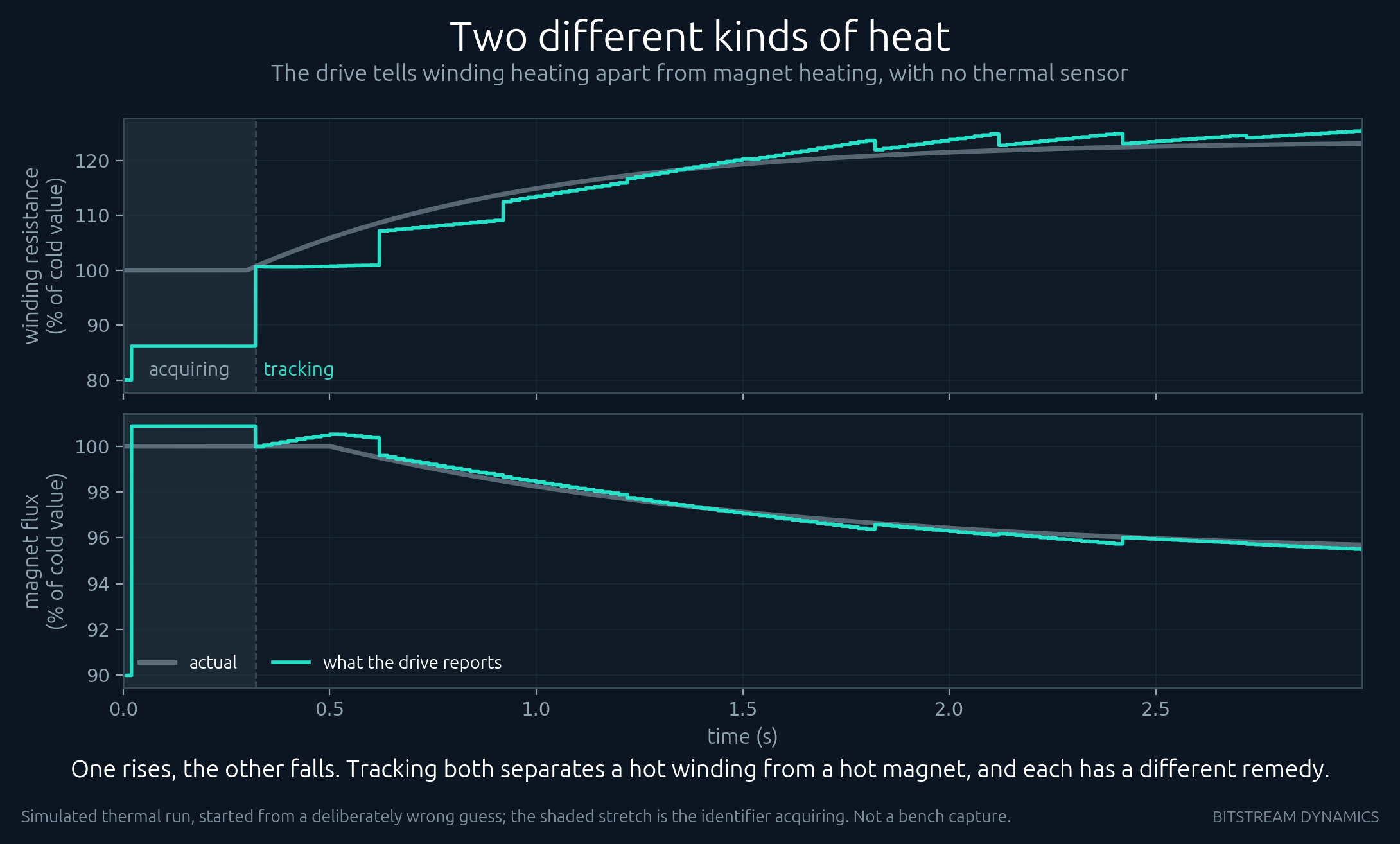
What drifts, and what it means
Slow changes in the electrical parameters map onto real, physical things happening inside the machine:
- Stator resistance rises with temperature. Winding resistance and copper temperature move together, so tracking resistance is a direct read on how hot the windings are running, and on whether cooling is degrading or the machine is being overworked.
- Inductance and flux shifts flag deeper trouble. Drift here can signal insulation aging, inter-turn faults developing, magnet health in permanent-magnet machines, or a saturating core, well before any of it becomes a failure.
- Connection and contact wear shows up too. A resistance that climbs at a joint rather than across the winding points at a loosening terminal or a corroding contact.
None of these needs a thermocouple, a current probe, or an inspection window. The drive is already measuring the signals; the health information rides along on the same telemetry link that carries commands and status.
Why the readout arrives in steps
The health estimate in the figure above does not update every control cycle. It moves in steps, and that is deliberate rather than a limitation. The estimate is averaged over a short window before it is published, because averaging is what makes it quiet enough to trust: it trades update rate for precision. Winding and magnet temperatures move over seconds to minutes, so a reading every few tens of milliseconds is already far faster than the physics it is tracking. There is nothing to gain from a noisier number arriving sooner.
The larger corrections have a different cause, and it is worth understanding because it shapes how you use the readout. They land just after the load changes. A resistance change and a flux change do not look the same to the drive: resistance shows up in proportion to current, while flux appears as a constant offset. Telling the two apart therefore needs more than one operating point, so every genuine change in load hands the estimator fresh information and it corrects accordingly. A drive held at exactly one current forever will still track, but it separates the two effects more slowly. In practice this is a non-issue, because real machines move through varied load anyway, and it is the reason the readout sharpens the more the drive is actually used.
From alarms to prognostics
A threshold alarm tells you something has already gone wrong. A trend tells you what is going to go wrong, and roughly when. Because the drive produces these parameter estimates continuously, you can log them, watch the slope, and act before a field failure rather than after one. That is the difference between calendar-based maintenance, replacing things on a schedule whether they need it or not, and condition-based maintenance, servicing a machine because its own data says it is time.
For a drone fleet that means uptime and safety, and a maintenance record per airframe. For a defense actuator program it means prognostics and health management, which is frequently the gate that decides whether an electric actuator is trusted in the first place. In both cases the value is the same: the drive stops being a black box and starts being an instrument.
The interesting engineering is in getting those parameters cleanly and continuously enough to trust the trend. That part is our own work. What this note is about is simpler and more useful to you: a well-instrumented drive already knows a great deal about the health of the machine it is turning, and there is no reason to let that go to waste.
Want your drive to report machine health, not just run the motor?
It comes from the sensing and estimation stack rather than from the power stage, so it ships in our soft-switching drives and can equally be licensed into an existing design. Start a diagnostic sprint.